Bilirubin (Total) (SBR)
Clinical Biochemistry
Background Information
Bilirubin is created as part of the red blood cell breakdown process. The liver removes bilirubin from the blood by converting it into a conjugated form (also known as direct bilirubin), which is then secreted into bile and removed from the body in stool.
The total bilirubin test is included in the liver function test profile as a marker of biliary obstruction and also used to assess neonatal hyperbilirubinaemia.
The conjugated bilirubin test may be requested separately.
Patient Preparation
No specific patient preparation is required
Sample Requirements
For adults, blood taken into a 5mL gold top tube (rust top for Acute Unit)

For children, blood taken into a 3.5mL rust top tube

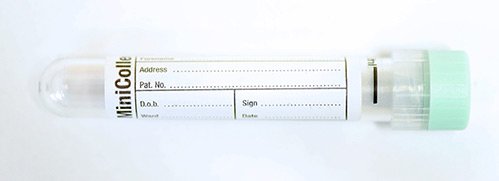
For neonates, blood taken into a 0.8mL minicollect lithium heparin tube. Please list the tests of particular interest so that some priority can be given to analysis if plasma volumes are small.
Samples from the community should be taken into a 0.8mL minicollect lithium heparin tube and protected from light.
Storage/Transport
Transport to the laboratory the same day at ambient temperature and avoiding exposure to light.
Required Information
Relevant clinical details. Medication or recent exposure to possible hepatotoxic agents. Recent foreign travel or contact with viral hepatitis.
Turnaround Times
The assays are run throughout the day and night. The in-lab turnaround time is less than 24 hours. The test can be ordered as an urgent request.
For neonatal bilirubin results the expected turnaround time is usually less than 3 hours.
Reference Ranges
Please note, there is variability between total bilirubin assays from different manufacturers in reported bilirubin measurement (NICE CG98) and the locally available laboratory assay should be used to guide management.
- Please refer to GHNHSFT local policy and to current NICE guidelines for up to date information on neonatal jaundice (links below)
- Please note: if paediatric samples are not protected from light at collection and take longer than 2 hours to reach the laboratory for analysis, the result may be more than 10% lower than the actual value (Rehak et a., 2007).
| Age | Reference range (µmol/L) |
|---|---|
| < 1 day | <103 |
| 1- 2 days | <137 |
| 2 - 5 days | <205 |
| 5 - 6 days | <190 |
| > 6 days - Adult | <21 |
Babies with prolonged jaundice (jaundice lasting more than 14 days in term or 21 days in pre-term) require a conjugated bilirubin level.
Conjugated bilirubin is assayed, when sample volumes permit, on all neonates with total bilirubin >60 µmol/L at ≥10 days old.
Further information
To learn more about bilirubin, visit Lab Tests Online
NICE CG98 Neonatal Jaundice (2010)
NICE CG98 Neonatal Jaundice Treatment Threshold Graphs
NICE CG98 Neonatal Jaundice: Threshold Table
Trust staff: Please refer to GHNHSFT policy M1091: Jaundice in Term and Preterm infants
References
Rehak NN, Cecco SA, Hortin GL. Photolysis of bilirubin in serum specimens exposed to room lighting. Clin Chim Acta. 2008 Jan;387(1-2):181-3. doi: 10.1016/j.cca.2007.09.019. Epub 2007 Oct 2. PMID: 17967443; PMCID: PMC2131702.
Page last updated: 01/07/2026 | Page last reviewed: 01/07/2026